Adaptive Physical Intelligence

The Operating Intelligence in the Physical World

Scroll

The Operating Intelligence in the Physical World

The vision, in under two minutes

One of the greatest ambitions of our time is to extend humanity's physical reach.

For decades, intelligence has become cheaper and more abundant on screens, but our ability to act in the world is still limited by labor, time, distance, and risk. Physical intelligence can change that. It can help us build more, care better, repair faster, manufacture at larger scale, and operate in places too dangerous or distant for humans, from industrial sites on Earth to future colonies beyond it.

There is more work than there are hands.

From the factory floor to orbit above, intelligence must act where humans cannot.

The need is already visible

By 2030, the global economy could face a shortage of more than 85 million skilled workers. Healthcare alone is projected to be short 11 million workers, and manufacturing more than 8 million. The cost is not only economic. Every year, nearly 3 million people die from work-related accidents and disease, many of them in the dangerous, dull, and dirty jobs that machines were meant to do. This is not about replacing humans. It is about giving civilization the capacity to do more, and to keep people out of harm's way.

85M
Skilled worker shortage
11M
Healthcare workers needed
8M
Manufacturing shortage
2.9M
Work-related deaths / year
330K
Fatal workplace accidents / year
60K
Construction deaths / year
210K
Agricultural deaths / year
200K+
Occupational cancer deaths / year

The shift

For decades, software ate every world except the physical one. A model could write your essay and still not open your door. A robot could ace the lab and fail the field. Not anymore. Intelligence is finally crossing from the screen into the machine. But acting in the world is a different problem than reading about it.

The first wave of AI was built for the internet. It learned from text, images, videos, code, and the traces of human knowledge. This worked because the internet is a record. A model can study that record and become useful inside the digital world.

The physical world is different. It is not a record. It is reality itself. When AI moves from screens into machines, the problem changes. The system is no longer only reading, writing, or predicting. It is moving through space, applying force, and dealing with weight, balance, and uncertainty.

The true metric of physical intelligence must be completion of work and adaptation, not prediction of the next action.

Big models see. Small models act. Large models understand the scene; small adaptive models act and adapt in it.

Two paths to the same wing

Evolution shaped one over millions of years. Intelligence is learning to shape the other in an afternoon.

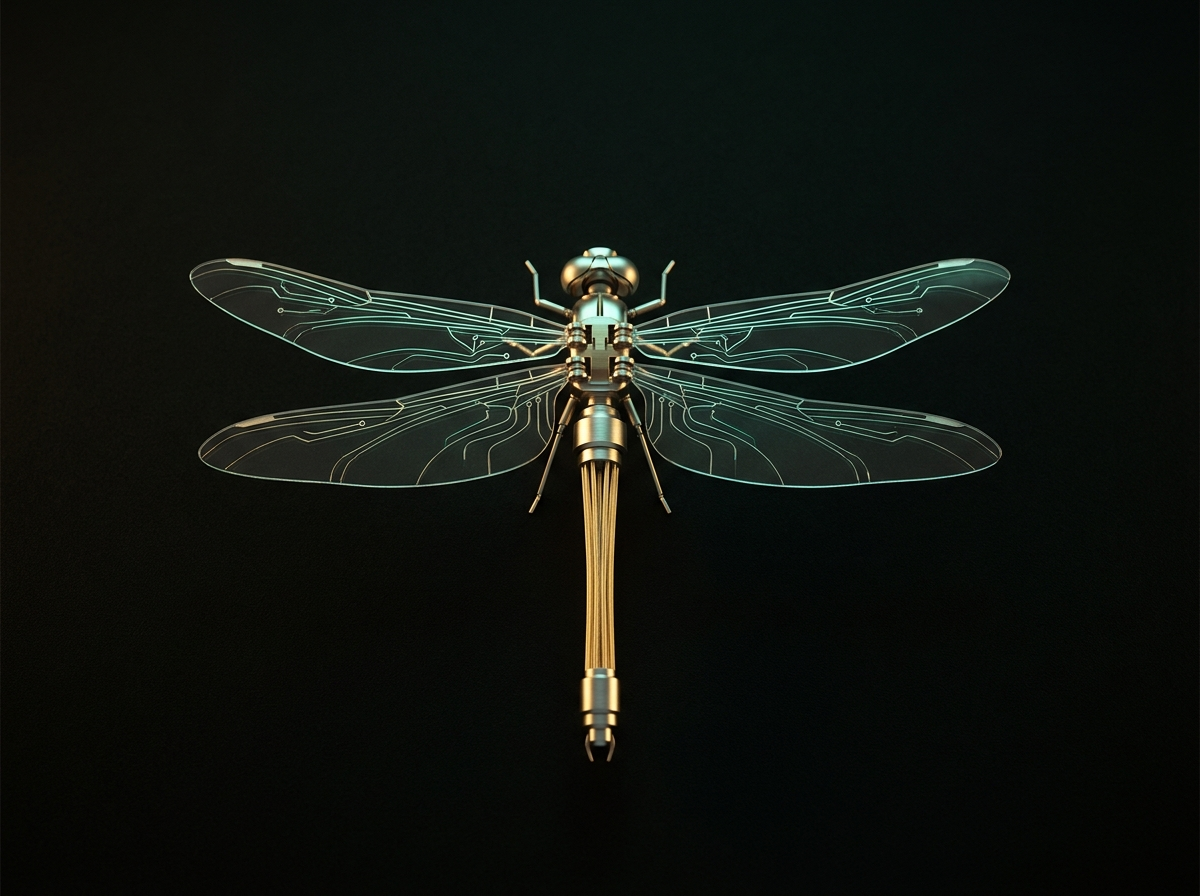
In nature, the environment shapes two things at once: the body, and the intelligence that runs it. Fins for water, wings for air, and the instincts wired to use them. Call them hardware and software. They adapt together, each refined by the world the other has to survive. Physical AI is entering the same loop. The hardware shapes what the software can learn; the software reshapes the hardware it runs on. Each makes the other better, and the loop never stops.

A real dragonfly, shaped by evolution
An engineered dragonfly built by AI

Small and adaptive

Frozen intelligence deployed today is not enough. A frozen model carries what it learned before deployment. But in physical work, the most important information often appears after deployment.

Frozen priors. Adaptive action. The large models stay frozen and carry what the world looks like; the model that acts stays small and adaptive, because its bottleneck is just physics, which is universal. Hyperopic instead of myopic, focused on completing the work by adapting, not on predicting the next action.

A frozen prior already carries the world's knowledge of how things look and what they are. The model that acts does not need to carry it again. Once the priors handle seeing, what remains is physics. And physics is universal. It does not need to memorize the world. Its job is to act in it, and to adapt. That is why it can be small.

Recent work on small reasoning systems confirms this direction. The Hierarchical Reasoning Model showed that small networks, organized to reason over different timescales, can solve difficult reasoning tasks with far fewer parameters and far less data than large language models. The Tiny Recursive Model pushed the idea further: a very small network can improve its answer by repeatedly refining its own reasoning.

Intelligence does not always need to come from size. It can also come from structure, recurrence, feedback, and adaptation.

Every era of technology reaches a little further into the world.

For fifty years, intelligence remade the digital, bits acting on bits. The frontier now is bits acting on atoms: machines that don't just describe the world but work in it. Beyond it lies bits acting on energy, a civilization learning to capture the power around it, from the grid to orbit to the fire of a star.

Each step reaches further out, and each is held back by the same thing: intelligence that breaks the moment it leaves the lab.

Geodesic is adaptive physical intelligence, the bridge from bits to atoms, and the groundwork for everything after.

Instinct It has never seen this leaf before. It builds anyway.
Adaptation The strike is adapted in the moment.

Adaptation is the oldest intelligence

A chameleon does not carry a model of every leaf it will ever meet. It senses, shifts, and survives. A tree does not predict the storm. It grows deeper roots. A flock of starlings does not rehearse every turn. Each bird adjusts to its nearest neighbors, and the swarm becomes a single mind.

Seeing, slow and inherited. Action, fast and adaptive. A chameleon carries evolution in how it sees, but adapts the strike in the moment. That is the architecture we build.

That idea matters deeply for the physical world. A machine should not only make one prediction and move on. It should observe, act, check, adapt, & act again. It should refine its understanding through contact with reality. It should become better because it is deployed.

This is closer to how humans learn.

Large models ask

How much can we learn before the machine acts?

Small adaptive models ask

How quickly can the machine adapt from what just happened?

The value is not in predicting what usually happens, but in adapting to what is happening here.

The frontier lab building adaptive models for physical AI.

We're hiring ambitious researchers and engineers working across robotics, vision, simulation, model adaptation, control, reinforcement learning, data engines, and AI-native developer tools.

Work with us